Gamdom Originals: Provably Fair Bitcoin Games & Odds
Updated November 2026
Licensed
 Available in AU
Fast payouts
18+ Only
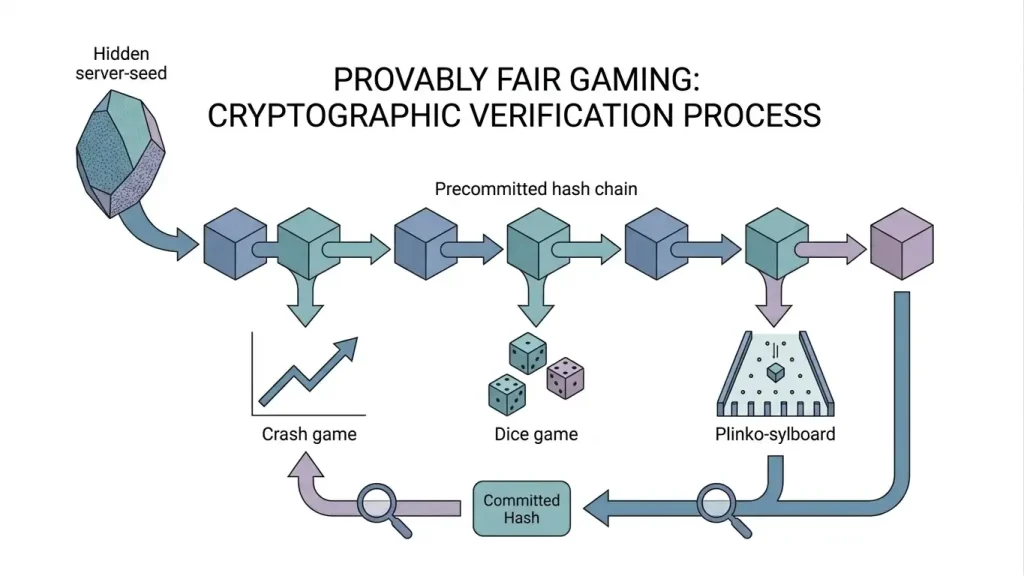
Table of Contents
- Verified Gamdom In-House Games and Fairness Checks
- What “provably fair” means in practical terms
- A simple four-step model
- What provably fair does prove
- What provably fair does not prove
- Originals versus third-party slots
- Originals versus live dealer games
- How Crash, Dice, Plinko, Mines, Hilo and Roulette differ
- Where crypto fits into the Originals story
- How to verify an Original rather than just trust the label
- Where Originals fit in the wider Gamdom platform
- Common misconceptions about provably fair games
- Practical decision guide
- Common questions about Gamdom Originals
- What Gamdom Originals add to the game library
Gamdom Australia Guide
Gamdom Originals are in-house games created by Gamdom and built around provably fair mechanics. The current official Originals guide names Crash, Dice, Plinko, Mines, Hilo and Roulette as examples. Instead of asking a player to accept every result as a black box, Gamdom describes a SHA256 hash-chain system that lets published game hashes be checked against a value committed in advance.
That verification model is useful, but it does not make gambling risk disappear, guarantee a win, or turn every Gamdom game into a provably fair Original. It applies to the in-house Originals layer. Third-party slots and live-dealer games are separate products with their own providers and game information.
Players looking for interactive table action can explore real dealer live casino tables with professional croupiers and multiple camera angles.
Verified Gamdom In-House Games and Fairness Checks
The official Gamdom Originals guide currently names six headline in-house games: Crash, Dice, Plinko, Mines, Hilo and Roulette. Those examples show that Originals are not one single game mechanic. They range from timing-based crash play to number, grid, card-prediction and roulette-style formats.| Original | High-level format | What this page verifies |
|---|---|---|
| Crash | Rising multiplier with a cash-out decision | Named by Gamdom as an in-house provably fair Original |
| Dice | Number-based outcome | Named by Gamdom as an in-house provably fair Original |
| Plinko | Drop-and-path style game | Named by Gamdom as an in-house provably fair Original |
| Mines | Grid selection with hidden hazards | Named by Gamdom as an in-house provably fair Original |
| Hilo | Higher-or-lower card prediction | Named by Gamdom as an in-house provably fair Original |
| Roulette | Gamdom’s in-house roulette-style format | Named by Gamdom as an in-house provably fair Original |
What “provably fair” means in practical terms
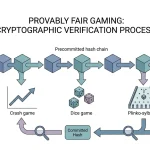
Provably fair is a cryptographic verification approach. The goal is to make the relationship between a committed value and later game results checkable rather than relying only on a claim that the game was fair. In Gamdom’s current explanation, the system uses SHA256 hashes arranged in a chain generated from a secret server seed. Gamdom says a commitment from that chain is published before the sequence is used. After a game finishes, its hash can be revealed. A verifier can hash that released value and compare the result with the linked value from the preceding step in the chain. If the relationship does not match, the chain check fails. If it does match, the result is consistent with the precommitted sequence described by the system. This is the core information gain of provably fair play: a player can independently check a cryptographic relationship after the event. It is different from simply being told that an internal system generated an outcome correctly.A simple four-step model
- Commitment: the operator creates the cryptographic sequence and publishes a commitment before later results are disclosed.
- Game result: the Original uses the predefined cryptographic material as part of its outcome process.
- Reveal: after the relevant game, the corresponding hash information is made available for checking.
- Verification: the player or an independent tool can apply SHA256 and confirm whether the disclosed hash fits the previously committed chain.
What provably fair does prove
Within the model Gamdom describes, the check can show whether a revealed value fits the precommitted SHA256 chain. That gives the player a way to test consistency after a round instead of relying only on the casino interface. Gamdom also publishes links to sample code for several Originals, which reinforces the idea that the verification step is meant to be reproducible outside the normal game screen. The strongest claim to take from this is narrow: cryptographic verification can make a particular outcome process independently checkable. It is a technical property of the game mechanism, not a general certificate for every part of the casino.What provably fair does not prove
Provably fair does not guarantee that you will win, and it does not make a negative outcome less possible. It also does not mean that every game on Gamdom uses the same verification method. The Gamdom game library includes third-party slots, table games and live dealer products alongside the in-house Originals. It also should not be confused with regulatory licensing. A cryptographic chain can tell you something about the integrity of the specific outcome mechanism it covers. It does not by itself establish Australian licensing, dispute protection, payment rights or local legal status. Finally, verification is not prediction. Seeing the hash information after a round does not provide a reliable method for knowing the next result in advance. The point is auditability, not a strategy for beating the game.Originals versus third-party slots
A standard third-party slot is produced by an external studio and delivered through the casino catalogue. Gamdom works with providers such as Evolution and Pragmatic Play across its broader global product, while other studios supply many of the conventional casino titles. In those games, the provider’s own rules, information panel and technical controls matter. An Original is different because it is an in-house Gamdom product. That changes both provenance and the way the game can be evaluated. Instead of starting with a third-party studio identity, you start with Gamdom’s own game design and its stated provably fair mechanism. That is why it makes sense to treat Originals as a separate child topic rather than mixing them into a huge provider list.Originals versus live dealer games
Live dealer products are different again. Gamdom’s live category uses real-time dealer streams, with Evolution and Pragmatic Play Live among the corroborated providers. The core experience is a video studio, a human dealer and table controls. Originals are compact digital games whose distinguishing feature is the in-house cryptographic verification model. If the presence of a real dealer is the main reason you choose a game, use the Gamdom live casino. If you care more about short digital formats and being able to inspect the verification logic, Originals are the relevant category. Neither format is inherently a better gambling decision, and both still involve the risk of losing money.How Crash, Dice, Plinko, Mines, Hilo and Roulette differ
The named Originals also demonstrate why one generic description is not enough. Crash focuses on deciding when to cash out as a multiplier rises. Dice centres on a number outcome. Plinko uses a path-style result. Mines is a grid-selection format with hidden losing positions. Hilo asks for higher-or-lower card predictions, while Roulette adapts a familiar casino concept into Gamdom’s own format. Those mechanics create different pacing and decision points, but they do not change the basic risk rule. A game can be cryptographically verifiable and still produce losing rounds. Choose a format because you understand how it works, not because the phrase “provably fair” sounds like a promise of favourable outcomes.Where crypto fits into the Originals story
Gamdom’s global platform supports cryptocurrency deposits, and its official Originals material describes the category as crypto-first. Those two facts help explain the product’s history and design language, but payments and fairness verification remain separate systems. A cryptocurrency transaction does not make a game outcome provably fair, and a provably fair game does not guarantee that a particular coin, payment route or regional cashier option is available to an Australian account. The dedicated Gamdom crypto payments covers supported cryptocurrencies and transaction questions separately. Keeping the topics apart prevents a common confusion between blockchain-style payment language and the cryptographic hashing used to verify game results.How to verify an Original rather than just trust the label
- Open the verification or fairness information for the specific Original you are using.
- Identify the published hash or commitment associated with the relevant sequence.
- After the round, obtain the game hash or result data that Gamdom exposes for verification.
- Use the documented SHA256 check or sample verifier to test whether the released value links back through the committed chain.
- If you cannot reproduce the relationship, do not assume the label alone proves the result. Recheck the instructions and the exact game data.
Where Originals fit in the wider Gamdom platform
Gamdom’s global platform combines casino games with sports and esports betting, but those are separate product areas. Originals belong to the casino side and should be evaluated as in-house games, not as sportsbook features or as evidence about local wagering availability. This separation also keeps the site architecture useful. The Gamdom Australia review covers the platform at a high level, the main games page covers catalogue breadth, and this page concentrates on the one thing that makes Originals different: their in-house origin and the ability to inspect a cryptographic verification process.Common misconceptions about provably fair games
- “Provably fair means I have better odds.”
- No. Verification and expected game economics are different questions. A checkable outcome process does not promise a positive return.
- “Provably fair means every Gamdom game works this way.”
- No. The verified claim applies to Gamdom Originals. Third-party slots and live dealer games are separate categories.
- “The hash lets me predict the next result.”
- No. The verification process is designed for checking consistency, not for revealing future outcomes in advance.
- “Provably fair is the same as being locally licensed.”
- No. Cryptographic verification and gambling regulation address different questions and should not be treated as substitutes for each other.